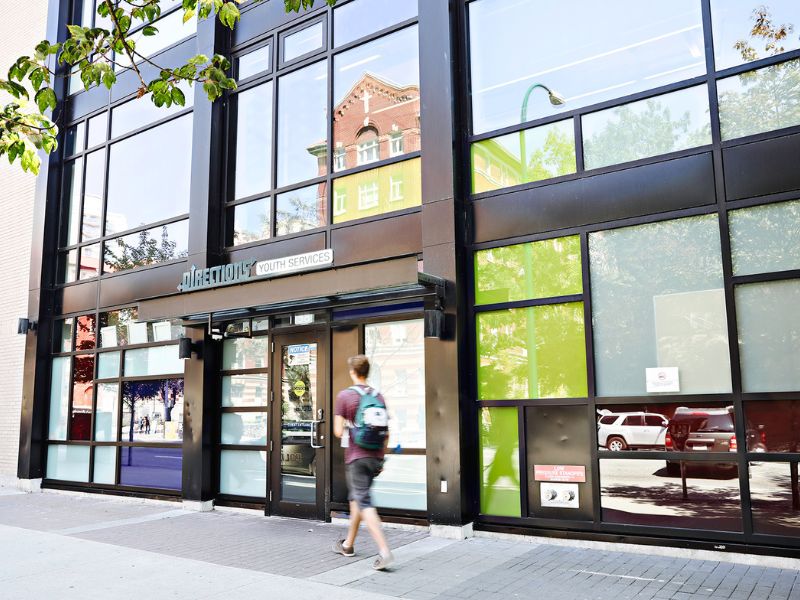
At Family Services of Greater Vancouver, the term “low barrier” is often used when we talk about our Directions Youth Services division. Today, we’re breaking down what it means when we say Directions Youth Services is low barrier.
At its core, being low barrier means that we try to have no or few barriers to accessing services. The exact requirements for participation vary depending on the program, but to receive support at the Directions Drop-In Centre we have as few requirements as possible, making finding help more accessible for youth.
So how do we create a low-barrier, accessible drop-in centre for unhoused and at-risk youth in Vancouver?
The directions drop-in centre is open 24/7/365
Being open 24 hours per day, every single day of the year, allows youth to get what they need when they need it. They can come after work, school, and appointments, or in the middle of the night. You can’t schedule a crisis, and the doors at Directions are always open for youth.
youth can get a hot meal before completing the intake form
At the Drop-In Centre, youth aren’t required to complete their intake form before getting dinner. While the intake process is important, particularly for reporting to funders and for informing our services, when someone is hungy: it can wait. The priority is to meet a basic need before we ask something of youth. And, relatedly, most of the intake form is optional. We don’t force people to disclose what they aren’t comfortable sharing, especially with the understanding that those with marginalized identities might be wary of institutions asking for that kind of information. This is part of how we build trust.
id is required, but we can help youth get it
While many of the intake questions are optional, we do have to verify clients’ ages (13-24). We typically request ID in order to do so, but when someone doesn’t have their ID, our staff are able to support the youth in getting them. When someone’s housing is unstable, it isn’t a given that they’ll be able to keep or maintain access to key documents. We’re here to provide support first and then help youth take that step. Plus we offer storage for important documents like ID for those who want to keep them in a secure location.
the drop-in centre is wheelchair accessible
With elevator access to the overnight shelter and accessible showers and toilets, the Directions Drop-In Centre is open and accessible to young people with mobility devices. This is important to keeping the entire facility low barrier to those who need it, especially when we know that people with disabilities are at a higher risk for homelessness.
We support youth struggling with mental health
Of course, not all disabilities are physical. And while not all mental health struggles are clinically defined as disabilities, Directions offers support and understanding when someone isn’t well.
There are no sobriety requirements to receive support
At Directions, we prioritize safety, dignity, and choice. This means that there are no specific goals or goal-setting requirements for accessing the Drop-In Centre. We don’t require sobriety (though substance use is not allowed on premises) the same as we don’t require any goal for clients to pursue sobriety. We are, first and foremost, a safe place for people to be, where you can meet their needs.
Youth can bring their pets to the directions drop-in centre
To wrap up this explanation of what “low barrier” means at Directions on a warm and fuzzy note: pets are welcome at the Drop-In Centre. Our on-site pet room can hose up to four pets per night. Pets are very common and important. In order to welcome someone in, we don’t ask them to leave their pets behind.
To keep our accessible, low-barrier facility open, Directions relies on the support of our community of Caring Neighbours. If you’re feeling inspired, we’d love for you to join today.